 Picard






Live Demo: Living City
Every car, junction, traffic light and district in this city is a Picard actor. Spawn thousands of vehicles, crash an actor and watch supervision restart it, or add a whole district at runtime. The simulation runs entirely in your browser: Picard compiled to WebAssembly, no server involved.
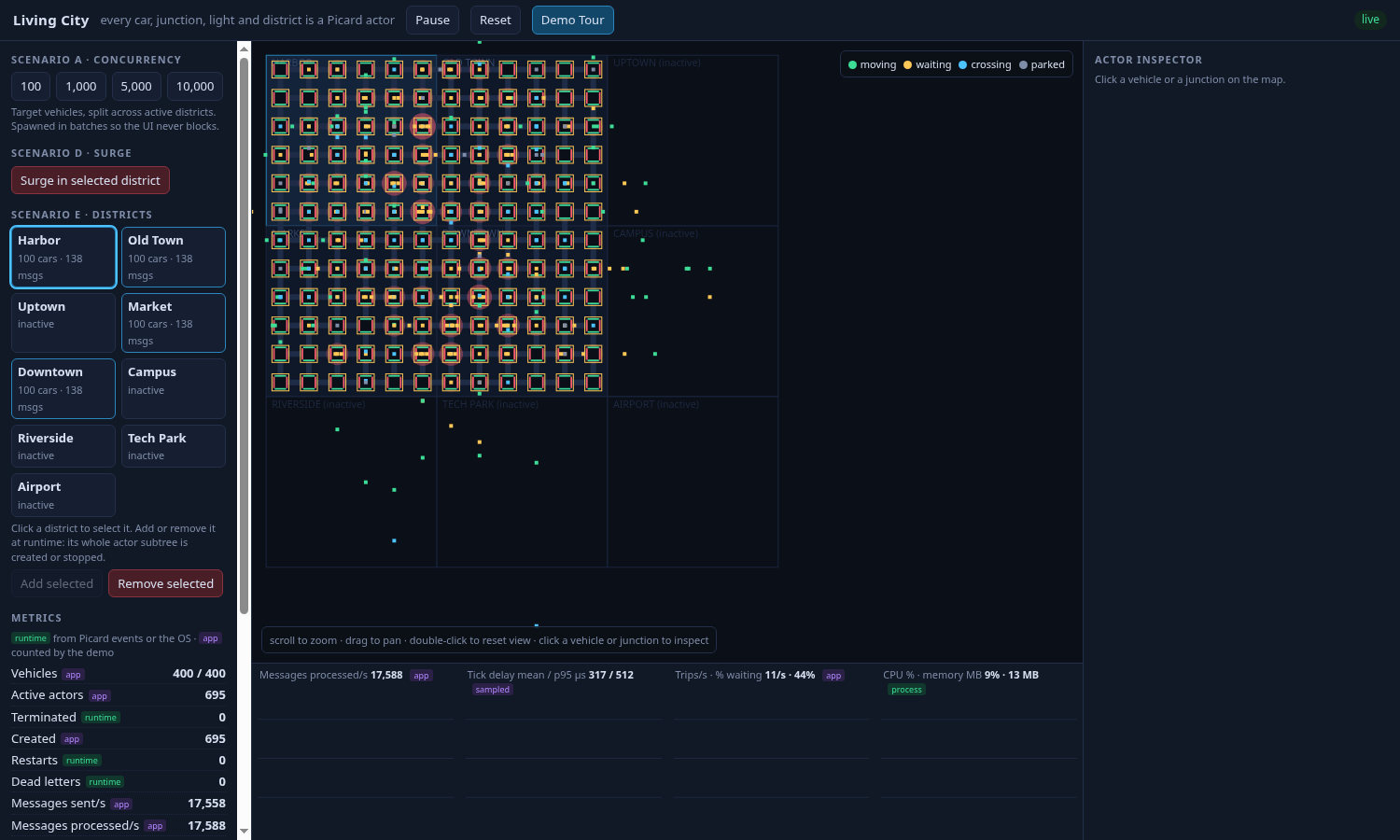 Launch the demo

Actor Based Concurrency
Actors expose a message based API resulting in fast, non-blocking code execution while also eliminating race conditions to make concurrent code a breeze to write.

Self Healing
Build applications that isolate and recover from failures. Actors provide a Supervision Strategy that form the core of resilient application design in Picard.

CQRS Entity Management
The separate picard-cqrs crate routes commands by entity ID and manages active entity actors. Your application supplies any persistence and state recovery.

General Purpose
In the Cloud, Microservices, IoT, Drones, AI and more. Rust compiles to OS binaries, has no VM or GC overhead, and requires only a few megabytes of memory.

Modular Framework
The runtime includes actor dispatch, logging, message scheduling, and configurable mailboxes. Optional features add diagnostics, serialization, a runtime console, and remote messaging.

Modern Rust Design
Execute Rust Futures with ease and no unsafe code used.
Example Code
1use picard::actors::*;23#[derive(Default)]4struct MyActor;56impl Actor for MyActor {7 type Msg = String;89 fn recv(&mut self, _ctx: &Context<Self::Msg>, msg: Self::Msg, _sender: Sender) {10 println!("received {msg}");11 }12}1314fn main() {15 let sys = ActorSystem::new().unwrap();16 let actor = sys.actor_of::<MyActor>("my-actor").unwrap();1718 actor.tell("Hello actor!".to_string(), None);19}20